Digital Money Foundation
The economic rationale of blockchain
10 October 2026
Introduction
Blockchain applications are gaining traction in financial transactions. A number of key blockchain finance projects are moving from concept to implementation. It offers a good opportunity to assess the contribution of blockchains in finance. Blockchain’s distinctive contribution lies in governance and infrastructure economics. The former may be relevant only for a very narrow set of transactions, while the latter could have broader relevance. More clarity is needed about the contribution of blockchain to assess its relevance for financial transactions.
Financial transactions are typically not constrained by technology. As a thought experiment: If everyone had an account at the same bank, it would solve most payment problems. Similarly, if all banks had an account at the Federal Reserve, all dollar payments would be simple. The former is due largely to compliance restrictions and the latter to policy. This also holds for securities and other financial instruments whose transactions are subject to the processing by different intermediaries and possible restrictions including opening hours. The layout of the securities lifecycle is not due to technological limitations.
The original blockchain, developed for bitcoin, aimed to establish a “peer-to-peer version of electronic cash [that] would allow online payments to be sent directly from one party to another without going through a financial institution.” It rests on an “electronic payment system based on cryptographic proof instead of trust.” Blockchain established a new financial market infrastructure based on an alternative governance arrangement.
The benefits of blockchains are generally attributed to their ability to place financial claims on shared programmable infrastructures, fractionalisation of ownership, thereby reducing reconciliation, integrating transaction and settlement processes and enabling automation, composability and atomic exchanges.1 These features are often presented as transformative for payments and securities markets though it is acknowledged that they are not intrinsic to blockchains.2 Fractionalisation is common through stocks and funds. The fundamental economic question has nonetheless largely remained unanswered when blockchain provides functionalities that conventional architectures cannot provide as effectively.
Institutional arrangements comprising legal, regulatory and compliance normally dominate financial transactions. While technical factors may facilitate financial transactions, they cannot supersede institutional arrangements. Few financial instruments can be transferred without some intermediation. This may limit the relevance of blockchains for a large group of financial transactions. It also risks conflating technological with economic possibilities, that is, a transaction may technically be possible but not economically.
The relevance of blockchain will be greatest where instruments need to be transferred peer-to-peer and where it reduces transaction costs. Where a neutral governance arrangement is needed, it may become the preferred financial market infrastructure.
Blockchain
Blockchain offers a unique operating environment for financial transactions. Processing and recording of transactions occur on the basis of a collective computing effort that solves for the “double-spend” problem without the need of a single party to validate transactions. Blockchain records, given its replicated nature, are tamper evident and practically immutable. Technical performance is increasingly unlikely to be the binding constraint on blockchain use in finance.
The use of blockchain is not instrument specific.1 Composability, the possibility to have different instruments coexist and exchangeable on a single network, facilitates financial transactions.
Modern blockchains can achieve transaction speeds compatible with many financial applications and operate continuously. Similarly, interoperability is increasingly a tractable technical problem, e.g., networks can be synchronised and instruments can be transferred across infrastructures through locking, withdrawal and reissuance mechanisms.
The replicated nature of blockchain offers complete transaction transparency. This may be incompatible with the requirement for confidentiality in financial transactions. Additional measures will therefore need to be taken to obscure transactions.
Blockchains can function as a repository of transactions or their proofs only or as transaction layer depending on the requirements for transaction speed and confidentiality.
Blockchain vs book-entry
The value of blockchain often conflates the technology with reorganisation of market infrastructure around a shared state and integrated workflows. Blockchain is not needed for financial claims to be issued, transferred, serviced and settled on shared digital infrastructures. It is also not required for compressing settlement cycles or offering delivery versus payment and other atomic transactions.
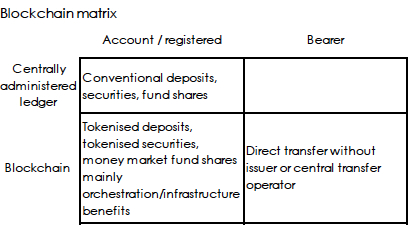
The blockchain matrix illustrates the unique combination of blockchain and neutral transferability. Book-entry system can replicate the functionality but cannot provide the neutrality in transfer consistent with bearer instruments. The empty quadrant illustrates that central registration preserves an operator whose ledger determines the transfer of ownership. It is in conflict with the fundamental proposition of a bearer instrument.
Financial transaction stack
Blockchain’s marginal value depends on what components of the financial transaction stack it replaces including instruction, validation, orchestration, scheme rules, processing, recording and settlement. Where blockchain minimises dependencies on other systems, its benefits will be greatest. This excludes instruction and execution layers that can remain external to the blockchain without impairing its functionalities.
Economically valid transactions must observe the relevant legal, regulatory and compliance provisions. Where those provisions require sequential validation during the transaction process, blockchain’s utility will be limited. Where external controls can be performed ex ante and the instrument is legally transferable on a bearer-like basis, blockchain can represent a fuller financial market infrastructure.
The role of blockchain in the stack can vary from representing solely a backend for processing and recording transactions upon external validation to performing transaction execution autonomously. The former benefits from the auditability, shared state, atomicity and programmability. The latter leverages the neutral governance.
Governance
Blockchain offers a unique governance arrangement. At protocol level, transactions are processed according to technical rules. Parties can delegate trust for transactions processing and recording to the network and do not need to entertain any bilateral relations among themselves. However, the validity of transactions—blockchain is only a technical ledger—will continue to be determined by local regulatory and legal provisions.
The cash cycle offers a similar governance arrangement. Banknotes are issued under specific provisions but once in circulation can be transferred peer-to-peer and acceptance of a banknote typically concludes the transaction. However, while a cash transaction may be technically concluded, it may not be legally valid as it may have breached prudential limits on the amount of permissible cash transfers.
The distinctive governance benefits of blockchain accrue therefore largely to instruments that can be transferred legally peer-to-peer without major restrictions. Those instruments need to exhibit properties akin to bearer instruments. In the transfer of such instruments technical and legal provisions typically coincide.
Instruments that require some intermediary arrangement to validate a transaction may greatly reduce the utility of blockchain. Tokenised deposits are unlikely to be transferable and will normally involve the issuing bank. Tokenised securities that require involvement of a CSD or custodian will similarly be constrained institutionally. Central banks will also always want to control who has access to their balance sheet.
Infrastructure
Blockchain is a readily accessible public financial market infrastructure. It may offer similar to the internet, it may offer the possibility to readily deploy different financial applications. The use of blockchain may be cheaper than using proprietary systems due to lower fixed costs. It may avoid duplication of parallel systems and offer large economies of scale.
The robustness of blockchain as a neutral environment rests largely on the level of decentralisation. Only highly decentralised blockchains de facto can ensure neutral governance and immutability. Decentralisation also provides operational resilience as a blockchain can continue to perform even if part of the network is down.
Blockchains represent external systems to every user. Most financial market infrastructures are owned and operated by a specific provider, e.g. a central bank for the payment system or a CSD for securities registration.
Blockchain similarly to any other financial market infrastructure should be seen as one part of an infrastructure set-up. As a technical ledger it can be combined with additional arrangements including schemes that determine the interactions of users. The relative dominance of technical versus other factors will determine the utility of blockchain.
Permissioned blockchains often continue to be the preferred approach to using blockchain in a financial setting. However, where validation and access is determined by a single party, the comparative advantage of blockchain is greatly diminished. Permissioned blockchains seem inconsistent with the distinct functionalities offered by blockchains.
Economic rationale
The utility of blockchain rests largely in its governance and public access. Where those features are desired or needed, blockchain can offer an important alternative to existing systems. The economic rationale of using blockchain therefore rests largely in producing neutrality and cost efficiency.
The neutrality of blockchain may offer an important second-best solution to systems that cannot guarantee needed autonomy. Where blockchain offers a neutral environment that is not controlled by any one entity, it may solve for external dependencies problems. However, the neutrality of blockchain will depend on its level of decentralisation. Efforts to preserve a high degree of decentralisation may be needed through e.g. participation in network validation.
The use of blockchain as a public infrastructure could produce important economies of scale. Use of blockchain may thereby be more cost efficient than developing, building and operating a proprietary system. Lower fixed costs may produce lower the barriers of entry which may deepen participation in financial transactions. This may be particularly important where high costs prevent financial market developments.
Conclusion
Blockchain does not alter the economic properties of money or assets, legal validity, compliance obligations or scheme rules. It changes the infrastructure on which transactions may be recorded and processed. Its economic rationale rests on whether the marginal benefit of neutrality, shared state and public infrastructure exceeds the cost and complexity of adding another layer to the financial system.
The benefits of blockchain are often attributed to its functionality and reorganisation of markets. However, where a financial instrument is inherently account-based or registered, blockchain's distinctive governance advantage is limited. Blockchain combines the functionality of digital bearer transfer with a governance structure consistent with bearer ownership.
1 See e.g. ECB, Towards an efficient and integrated digital capital market in Europe: the role of tokenization and the Eurosystem’s policy response, Macroprudential Bulletin 33, April 2026. BIS, Next-generation monetary and financial system takes shape, based on a tokenized unified ledger, 24 June 2025; Bank of England, The Bank of England’s approach to innovation in money and payments
2 See e.g. ECB, Speech by Isabel Schnabel, Member of the Executive Board of the ECB, at the Jackson Hole Economic Policy Symposium on “Financial Innovation: Implications for Payments and Policy”, 28 August 2026
3 The bitcoin blockchain was originally designed for bitcoin only. Subsequent blockchains have taken a more instrument-neutral approach. Even the bitcoin blockchain today allows issuance of other instruments.